

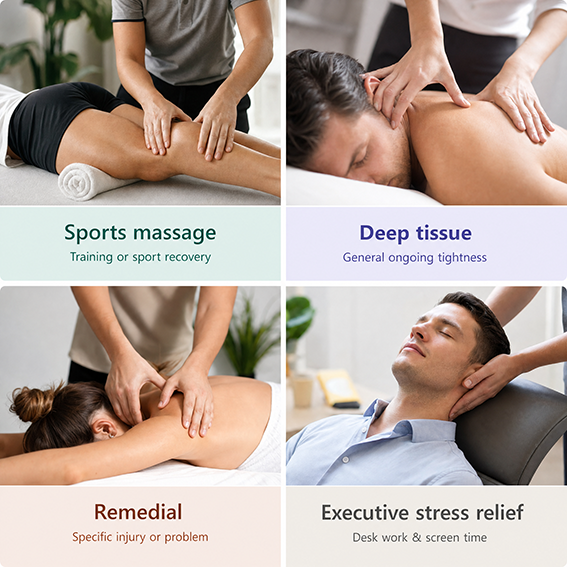
If you’ve ever stared at a massage menu trying to work out the difference between “sports,” “deep tissue” and “remedial,” you’re not alone — and here’s the honest answer: these three overlap far more than the names suggest.
All three use firm, targeted pressure to release tension, improve blood flow, and break down the tight knots (adhesions) that cause pain and restricted movement. The real difference isn’t the technique — it’s why you’re booking. Here’s how to work out which one actually fits what your body needs right now.
Sports Massage — When It’s About a Specific Activity
If you’re training for something, recovering from a specific activity, or managing the wear-and-tear of a sport you play regularly, sports massage is built around that. It targets the muscle groups your particular sport loads the most, and it’s typically timed around training or competition — before an event to prime the muscles, or after to speed up recovery.
If you play padel: the sport’s explosive lateral movement, twisting rotations and overhead smashes load up the shoulders, forearms and lower back in a very specific way. With padel’s rapid growth across Sandton, Dunkeld and Randburg right now, this is one of the fastest-growing reasons people are booking sports massage in Johannesburg — the shoulder and forearm strain from a few sessions a week catches up with people faster than they expect.
If you play golf: the repetitive, one-sided swing creates imbalances that a general massage doesn’t address — tight hips, one-sided shoulder and lower back tension, all from loading the same rotational pattern hundreds of times a round. Sports massage for golfers looks at the whole kinetic chain, not just wherever it happens to be sore that week.
If you run, cycle, or train at the gym: the trouble spots are more predictable — calves, hip flexors and IT band for runners; lower back, quads and neck for cyclists; shoulders, upper traps and lower back for regular gym-goers. Sports massage timed around your training cycle helps you keep training instead of sitting out injured.
Deep Tissue Massage — When It’s About Chronic Tightness
Deep tissue massage uses slower strokes and more sustained pressure to reach the deeper layers of muscle and connective tissue. It’s the right call when tension isn’t tied to one specific activity — it’s just persistently there, week after week, regardless of what you did that day.
This is often where desk-related tension lands. Hours of screen time and minimal movement create a different pattern of tightness to sport-related strain — less “this specific muscle is overworked” and more “everything through the neck, shoulders and upper back has quietly locked up.”
Remedial Massage — When There’s a Specific Problem to Fix
Remedial massage is the most targeted of the three, but it’s not a fixed, formulaic process — it’s responsive. Lauren adjusts pressure, technique and focus based on what she feels in the tissue as the session progresses, working into tight areas, old injuries or persistent problem spots as they come up under her hands, rather than following a set routine regardless of what’s actually there. If you’ve got a specific area that’s been a persistent problem — an old strain, a shoulder that’s never quite felt right — let her know when you book, and the session builds from there.
If It’s Really About Your Desk Job
If your honest answer to “what’s causing this” is “I sit at a screen most of the day,” this is a slightly different conversation — the tension pattern from prolonged sitting and forward head posture (“tech neck”) is specific enough that we built a dedicated session around it. Executive Stress Relief is a focused 45-minute treatment targeting exactly the neck, shoulders and upper back tension that desk work and screen time create — read more about why that happens in our tech neck guide and how often to book one.
So Which One Do You Actually Need?
| Your situation | Best fit |
|---|---|
| Training for or recovering from padel, golf, running, cycling or the gym | Sports Massage |
| General tightness with no single cause, not tied to one activity | Deep Tissue |
| A specific injury or chronic problem area | Remedial |
| Neck, shoulder and upper back tension from desk work and screen time | Executive Stress Relief |
Still not sure? That’s a completely normal place to be — message us and we’ll help you figure out the right fit before you book, rather than guessing.
Frequently Asked Questions
Is deep tissue massage the same as sports massage? They use similar techniques, but sports massage is built around a specific activity or training cycle, while deep tissue addresses general chronic tightness without that activity-specific focus.
Which massage is best for padel-related shoulder and forearm pain? Sports massage, ideally timed a day or two after a heavy session rather than immediately before or after play, so the muscles have time to actually benefit from the deeper work.
Can one session cover multiple problem areas — for example, golf-related back pain and general desk tension? Yes — many clients have both an activity-related pattern and a desk-related one. Mention both when booking so the session can be built around addressing each.
How do I know which type to book if I’m not sure? Message us directly with a quick description of what’s going on — what you’ve been doing, where it hurts, how long it’s been an issue — and we’ll recommend the right session rather than you having to guess from a menu. Once you’re on the table, Lauren also adapts as she works, based on what she feels in the tissue, so the session isn’t locked into a rigid plan either way.
Book Your Session
Whatever’s brought you here — a hard week on the padel court, a golf swing that’s catching up with you, or a desk job that’s quietly wound up your shoulders — there’s a session built for it.