

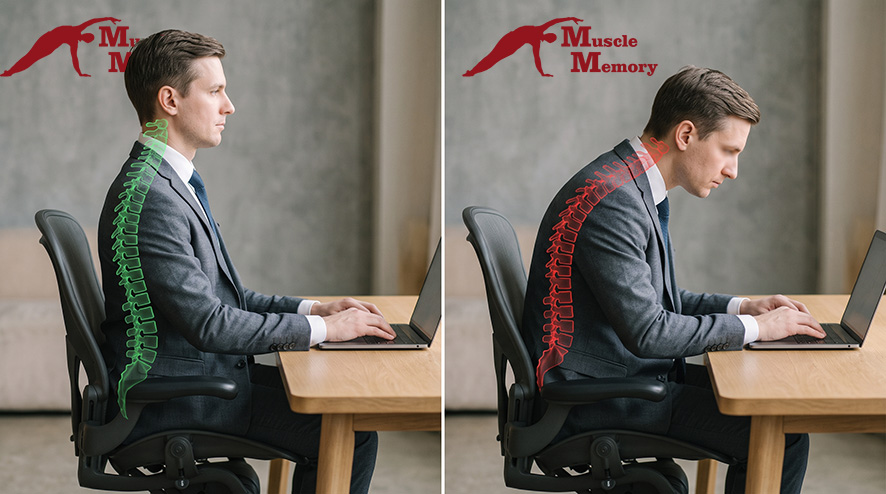
If your neck feels tight by 11am, your shoulders creep up toward your ears somewhere around your third Teams call, and you’ve started getting headaches you can set your watch by — you’re not imagining it, and you’re far from alone.
It’s called tech neck (sometimes “text neck”), and research puts the numbers higher than most people expect: up to 70% of office workers experience neck pain at some point in their careers, with one major study finding that 55% of office workers reported neck pain and 38% reported shoulder pain within just the past 12 months. Screen time is the common thread — and for anyone working a desk job across Johannesburg’s corporate corridor, from Rosebank to Sandton to Illovo, that’s most of the working week.
What’s Actually Happening in Your Neck and Shoulders
Tech neck isn’t just “bad posture” in the vague sense people usually mean. It’s a specific, measurable postural pattern: your head drifts forward and down toward your screen, hour after hour. In a neutral position, an adult head weighs roughly 4.5–5.5kg — but for every inch it tips forward, the effective load on your neck and upper back muscles increases dramatically. Your body is quite literally carrying extra weight, for eight or nine hours a day, every day you’re at your desk.
Those muscles — the ones running from the base of your skull down through your upper traps and shoulders — respond to that sustained load the only way they can: they tighten. Over weeks and months, that tightness stops being occasional and starts being your new normal. That’s usually the point where people describe it as “I just always feel tense there now,” or notice they’re getting tension headaches two or three times a week.
Why This Hits Different for Desk-Bound Professionals
It’s not just the hours at your desk. It’s the whole day, stacked:
- The drive or commute into Rosebank, Sandton or Illovo, often gripping a wheel or hunched over a phone in traffic
- Back-to-back meetings, laptop propped on a desk that was never actually set up for you
- Checking your phone during the ten minutes between calls
- The stress itself — tension held in the jaw, shoulders and neck is a well-documented physical response to a demanding, always-on workload
None of these individually feels like much. Stacked daily, they add up to a body that’s rarely, if ever, given the chance to actually release.
Quick Wins You Can Start Today
Before we get to how massage helps, a few genuinely useful habits worth building in — these won’t undo months of tension on their own, but they slow down how fast it builds back up:
- The 20-20-20 rule: every 20 minutes, look at something roughly 20 meters away for 20 seconds. Gives your neck a genuine, if brief, reset.
- Monitor height: the top third of your screen should sit at eye level, so you’re not tipping your chin down to read it.
- Phone habits: try holding your phone up closer to eye level rather than looking down and forward, especially for longer reads.
Good habits reduce how quickly tension rebuilds. They don’t release tension that’s already there — that takes hands-on work.
Why Massage Works Where Stretching Alone Doesn’t
Stretching and ergonomic fixes address the habit. They don’t undo the tissue changes that months (or years) of that habit have already caused — the tightened muscle fibres, the restricted movement, the trigger points that keep firing pain signals even when you’re sitting up straight.
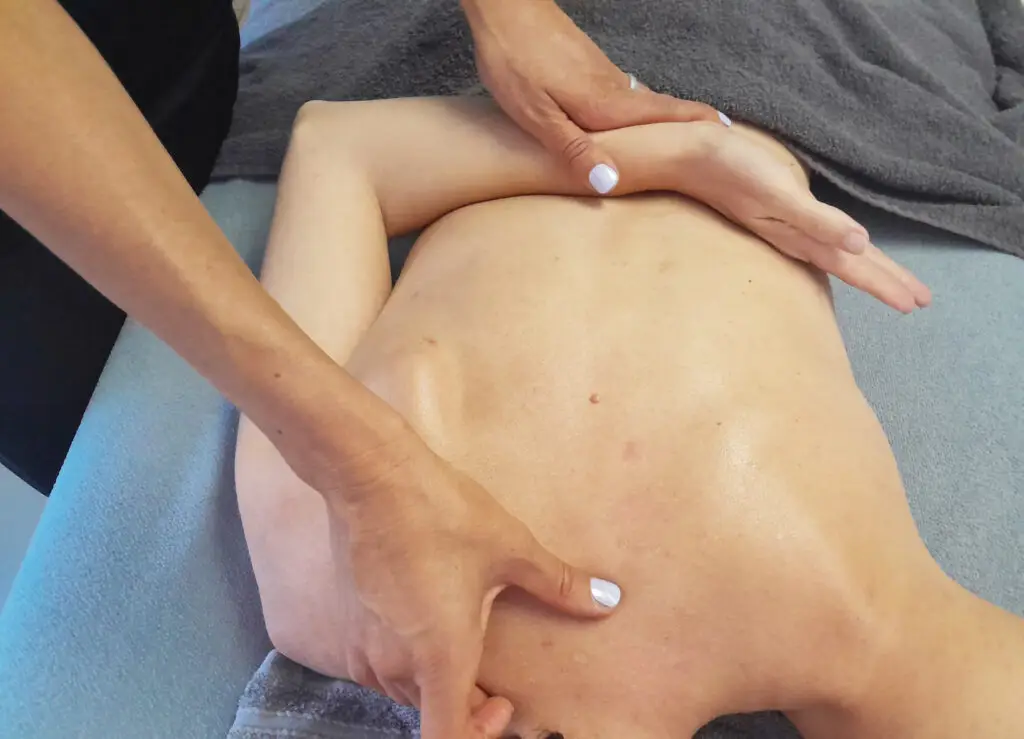
That’s where a targeted, hands-on session makes the difference stretching alone can’t. Our Executive Stress Relief session is built specifically for this: a focused treatment engineered to release the chronic tension patterns caused by postural stress and tech neck. By working directly on the primary stress-holding areas of the upper body — the neck, shoulders and upper back — it relieves tension headaches, frees up restricted shoulder movement, and restores a posture that actually feels comfortable to hold, not just correct on paper.
What to Expect
A session is 45 minutes — genuinely lunch-hour friendly if you’re based near Rosebank, Sandton, Illovo, Houghton or Melrose Arch, all a short drive from the Saxonwold studio. You’ll be back at your desk within the hour, and most clients notice the difference in tension headaches and shoulder mobility immediately.
Frequently Asked Questions
How often should I get a massage for desk-related neck and shoulder pain? For ongoing desk-related tension, most clients see the best results with a session every 2-3 weeks — enough to keep tension from fully rebuilding between visits. If pain is more acute, closer together initially, then spacing out as things improve, works well.
Is Executive Stress Relief the same as a relaxation massage? No — it’s a targeted, results-focused treatment aimed specifically at the neck, shoulders and upper back, rather than a full-body relaxation routine. It’s built for people who want a specific problem addressed, not just a general treat.
Will one session fix my posture permanently? One session provides real, immediate relief from tension and restricted movement — but posture built up over months of desk work is maintained, not permanently “fixed” in one visit. Combined with the habit changes above, regular sessions keep it from building back up.
Is it painful? It’s firm, targeted work — some areas may feel tender if they’re particularly tight, but it shouldn’t be sharply painful. Every session is adjusted to what your body can comfortably handle.
Book Your Session
If your neck, shoulders or head have been quietly asking for a break, this is your sign. Book your Executive Stress Relief session — 10 minutes from Rosebank, Sandton, Illovo and Houghton.